Posts

BDEC's district energy report gets a fresh preface -- a 30 year update

Image
There is a proposal being pushed by Burlington Electric Department (BED) to connect a steam transmission line between the J.C. McNeil Generating Station and the hospital. It's not good. Indeed, it's an idea that should have been stopped early at an internal BED meeting after about 10 minutes of discussion. In 1992, Dermot McGuigan and I developed a project proposal to serve Burlington with low-temperature district heat that would have taken heat from the cooling water at the McNeil Generating Station. It was a project for its time and the future, which is now here.  In 2023, district energy system supply temperatures in new systems are so low that uninsulated pipes can be used. (Lund, et.al., 2014,  https://doi.org/10.1016/j.energy.2014.02.089 ) created a widely reproduced graphic that illustrates the long-running temperature trend in district energy systems (also called district heating and cooling). The notion of using steam in a new system today is unfathomable. (Lund, et.a...

VT PUC Case No. 23-1870-PET, Public Comment

 My public comments ( PDF ) entered in Case No. 23-1870-PET : July 3, 2023  Vermont Public Utility Commission  Case No. 23-1870-PET  Dear Commissioners,  Thank you for the opportunity to comment on Case No. [ 2 ]23-1870-PET, as requested by the Commission’s Procedural Order of June 9, 2023.  Some time ago, I participated in the Public Service Board’s Docket #5611, an investigation into environmental externalities. There is one memory that I would like to share with you:  The investigation lasted many months and involve[d] utilities, environmental groups, and of course, the Department of Public Service (PSD, then DPS). Beginning in September 1992, Docket #5611 was a series of workshops on the general problem of environmental externalities and included greenhouse gas regulation. It was a thorough investigation using the best available information from the best universities and think tanks. I’ve lost track of the number of day-long meetings we had. It was...

Affordable Heat Act is not the climate action we need

 As Published on VTDigger, May 4, 2023 : Gish, Duval & Adams: Affordable Heat Act is not the climate action we need May 4, 2023, 7:07 am This commentary is by Chris Gish, Peter Duval and Ashley Adams. Duval lives in Underhill and participated in a Vermont Public Service Board investigation of environmental externalities. Adams, a business owner, lives in Burlington. Gish, a farmworker, lives in Burlington and organizes with Stop VT Biomass. The  Affordadable Heat Act,  S.5, would be a major step back for climate action in Vermont. The core of the bill was developed in closed-door meetings by some of Vermont’s biggest polluters, bypassing grassroots environmental groups and the Climate Council. It heavily favors biofuels that would push Vermont further from its climate goals.  As S.5 has advanced to the governor’s desk — likely to be vetoed and returned to the Legislature for further debate and a veto override attempt — more than 30 organizations and 230 individua...

Concession

  November 8, 2022 Election Results:  Governor Scott, congratulations on another victory.  Voters, thank you for voting and casting 4714 votes for me and the campaign that emphasizes an Earth perspective on issues. Voting is just the beginning. With hybrid meetings and online meeting packets, it is easier than ever to find an issue, research it, and track it through the political process.  Let me know, through the Take Action or Contact page, what issues interest you.

Real-Time Ridesharing

Image
This is not that bold. And it is not Uber. It's more just looking at the facts and realizing it's way past time to act. Here are some facts: Vermonters drove many kilometers solo in their cars. Vermonters spent a lot of money on their cars. Vermonters spent many hours in traffic delays...solo in their cars. Vermont cars spend most of their time just taking up space and idly depreciating. Vermont has many lane kilometers (lane miles) of Interstate, Limited Access, State Highway; and, Class 1-4 Town Highway, which are empty most of the time. While we have been driving, other people around the world have been living lightly and more economically. We have a lot of catching up to do, and we can't if we are still driving cars. The goal for everyone -- in every measure -- is zero. Zero fatalities. Zero impact. Zero emissions. Zero combustion. If there is a bold idea here, it is the realization that zero combustion means eliminating all internal combustion engine vehicles from Verm...

They Just Don't Get It

Image
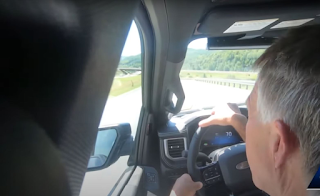
TL;DR: The insurmountable problem with electric cars is that they are cars. Phil Scott got a new truck. Brenda Siegel wants it too, and also wants everyone else to get an electric car. The F150 Lightning is a fine pickup truck, I'm sure. But will the planet survive 8 going on 10 billion people cruising around in electric vehicles? Clearly, no. Phil and Brenda just don't get it. It doesn't matter how green a car is. It could have zero embodied emissions from production and zero emission during its operating life. It could be free of mining, shipping, and casualty costs. It's the fact that it's an automobile with tires , one that takes up space and infrastructure, in a garage or rolling down a road -- fundamentally incompatible with a living planet.  Roads themselves are sufficiently damaging to make everything else associated with them unacceptably unsustainable. Vermont's rural road system is the worst of the worst. Vermont has 30% more lane miles per capita...

Ensuring a good start

Image
TL;DR: Parent or child stipends and paid family leave appear to be effective ways to ensure infants and toddlers get a good start. 'Fund the child, not the child care center' may be the catchphrase. Possible additional efforts include Grade 13, livable minimum wage, a 4-day workweek, and remote work. My campaign has been about changing the debate and uncovering underlying patterns that connect the issues. For every crisis, we must ask, "Is the question well-posed? Is it accurate framing? What are the alternative ways of looking at it? Is it a solution posed as a problem? Does it describe the bottom of the problem, or is there something deeper? What links it to other crises?" A report to the Legislature by Regenstein and Patel recommends creating "a new unit of state government that is focused entirely on early childhood." -- https://legislature.vermont.gov/assets/Legislative-Reports/Vermont-Child-Care-and-Early-Childhood-Education-Systems-Analysis-Final-Repo...